With the markets and financial media focused on the world of AI and technology, it’s hard to care about rare earth metals. However, rare earth metals are important to the modern world and power the latest technologies. Rare earth metals are used for camera lenses, hybrid car batteries, magnets for Electric Vehicle motors, wind turbines, smart phones, hard drives, missiles, military jets, robots, atomic clocks, powering datacenters that run the AI models and many other important technologies. However, despite the importance of these metals, it is known that China has a complete monopoly on these rare earth metals. China ended up controlling the market for rare earth metals as China lowered the metal prices, lowered environmental regulations, etc. to completely control the market for rare earth metals. Some estimates say that China controls 60 to 70% of mining and 90% of refining and processing of the metals.
Like other commodities, rare earth metal stocks have been falling. One reason may be the war in Persia increasing interest rates. High interest rates tend to lower the prices of metals. The sector is made of companies that still need to produce the metals; which makes it a higher risk space. I have been nibbling a position in rare earth metals (Not my recommendation, just my opinion).
The Trump administration has tried to support the rare earth metal sectors:
- Bought a 15% stake in MP Materials, which produces Neodymium-praseodymium and produces magnets. The government promised to buy all the magnets for the next 10 years. A fixed price floor of $110/kg on NdPr oxide. This support is different from the past as it lowers the risk for the company. In the past, China would lower the prices and put MP Materials out of business. Federal support has been given to USA Rare Earth, Lithium Americas, Trilogy Metals, etc. These are all publicly traded companies.
- Project Vault which has 12 billion dollars to purchase a stockpile of critical minerals which includes rare earth metals. The US government would stockpile metals during the Cold War but sold them all. This would be a step in the right direction in supporting the market and developing the supply chain for rare earth metals.
- Joint ventures with other countries when it comes to refining and processing of the metals.
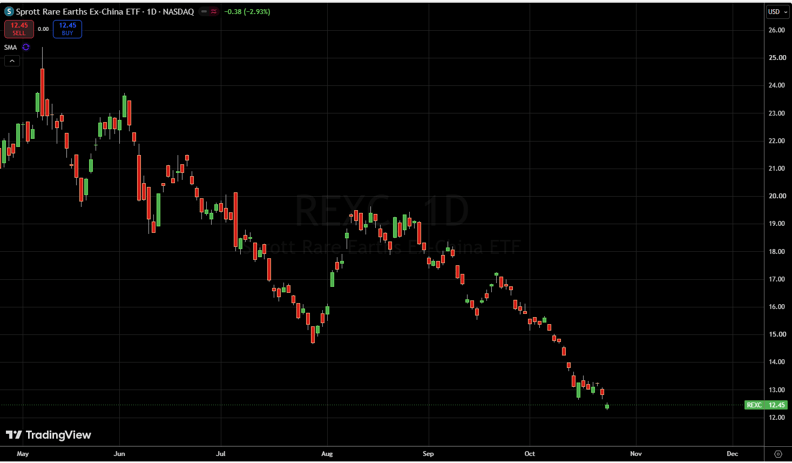
One ETF I am looking is the Sprott Rare Earth EX China ETF (REXC). I would prefer to invest in names that operate outside of China. The reason being that I would prefer to bet with the government in developing the domestic supply chain. It invests in companies with operations in Greenland, US, Australia, Brazil, Canada, etc. However, it invests in a lot of early-stage companies, which tend to be very risky.
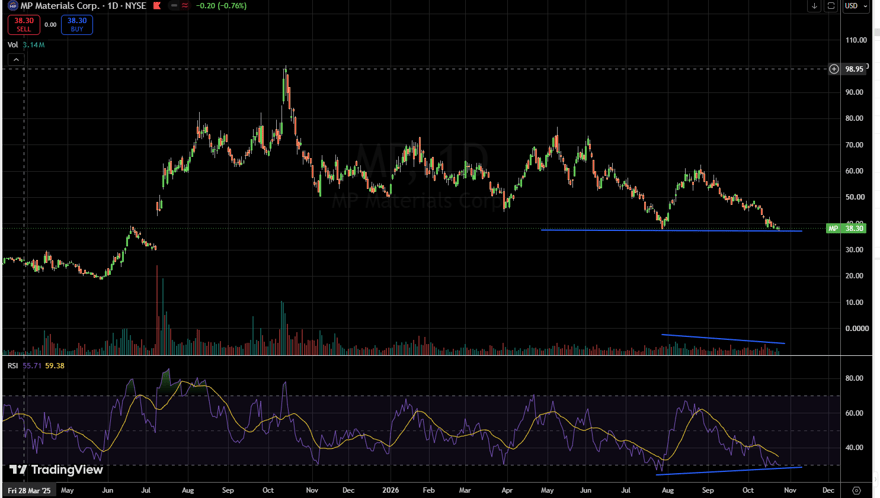
The other name I am looking at is MP Materials, which is the largest name in the rare earth metal space and has the largest allocation in the REXC ETF mentioned above (not a recommendation, just my opinion). The US government has taken a stake in it as well. It mines neodymium-praseodymium and makes magnets which are sold to robotic companies, electric vehicles, wind turbines, smart phones, etc. It sells to General Motors and Apple. Currently, the stock is selling at 52-week lows, RSI is showing positive divergence, and lower volumes. This can mean that the selling is getting exhausted, but the stock can still fall.
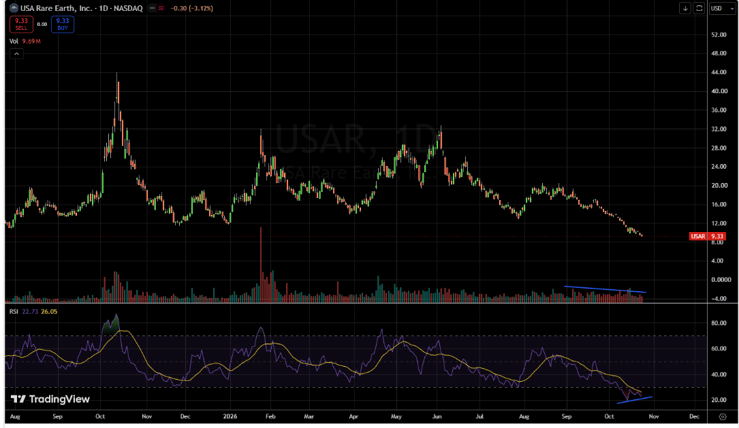
USA Rare Earth is an interesting name as the company is trading below price to book value at .90. The company has strong cash pile of $1.5 billion dollars, which is 43% of market cap (October 25, 2026). The Company produces Neodymium, Praseodymium, Dysprosium, Terbium. It uses these metals to produce magnets like MP materials. The deposit the company owns also has 15 of the 17 rare earth metals. The US government is supporting it with loans, stock investment, warrants and 15-year offtake agreement for their Brazilian operations. The offtake agreement is valued at around 1.55 billion dollars. Just like MP Materials, the company is at 52-week lows, has positive RSI divergence, and has declining volume.
Working notes. I used AI only to clean grammar. The views are mine. Not investment, tax, or legal advice.


Leave a Reply